
Maybe you’re wondering if you can get your metal patio furniture looking good again. Everyone knows only metal furniture will survive for years in the Valley of the Sun. It’s pricey, but it will hold up to our punishing sun. After a couple decades of exposure, no doubt it has faded and has flaking paint, and probably some rust, too. Electrostatic paint can renew your furniture.
If you work maintenance at a school or gymnasium and your lockers are ancient. You might be wondering if you can refurbish them to a factory-like finish. Electrostatic paint could be the answer. If you are a homeowner with a humble backyard pool, or a property manager at a hotel or apartment complex, or a Scottsdale resort property with fabulous pools and pool furniture, has the pool fence paint faded to flat and become powdery – you might want to know more about electrostatic painting.
You’ve probably seen electrostatic finishes without realizing it – on shelving, file cabinets, bathroom partitions, commercial equipment, and many more products. This process is common
in manufacturing, and it’s becoming more common in repainting out in the field, making Arizona metal products look like new. Wouldn’t it be nice to get another 15 years or more out of your patio furniture? Of course it would.
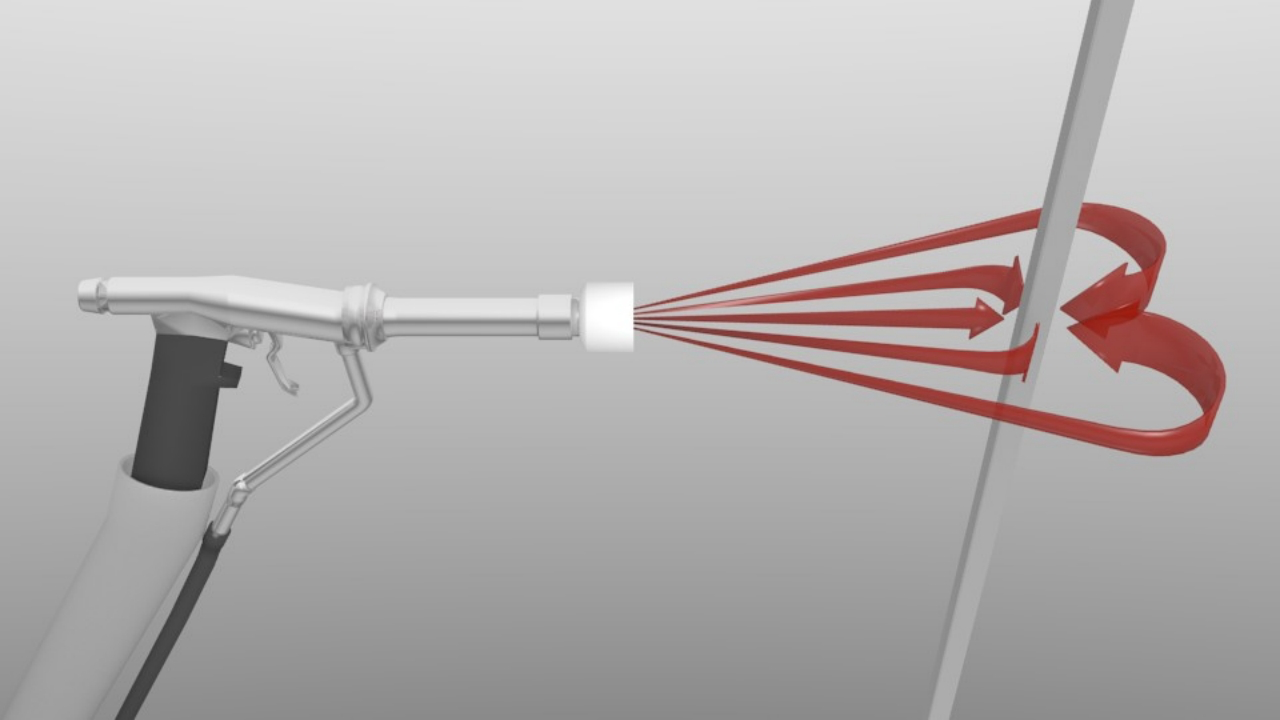
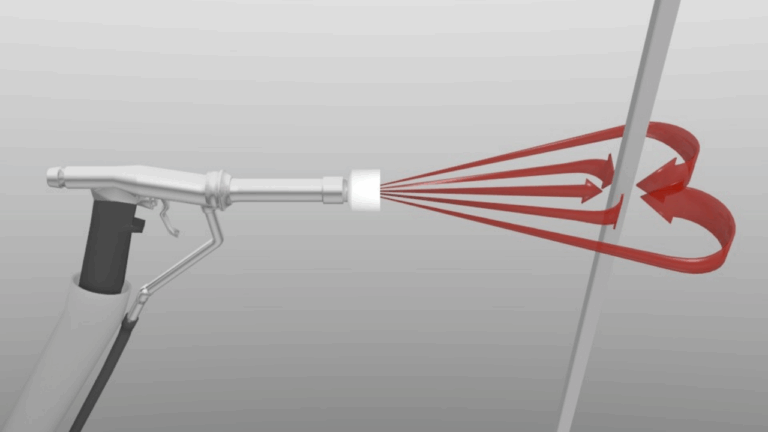
Electrostatic painting uses precision technology to paint a metal surface cleanly giving a fine hard finish. The negatively charged object and the positively charged paint are drawn together like iron filings to a magnet. This attraction allows for a smooth, high-quality finish. It’s completely safe and environmentally friendly.
Electrostatic painting has been used in the controlled environments of factories for many years. More recently, mobile equipment was developed that allows coatings to be electrostatically applied outside of controlled environments.
Just as with magnetic fields, two electrostatic objects with oppositely charged particles will automatically attract one another. This is the core idea of electrostatic painting, which harnesses these electrostatic fields to paint metal objects more quickly and cost efficiently. This application process works well with the high end two-component polyurethane enamel coatings which are more durable than architectural paints.

What are the benefits of electrostatic painting?
Electrostatic painting offers several compelling benefits, especially in industrial and commercial applications. Key advantages are uniform and smooth finish, reduced wasted paint, faster application, easier cleanup, durability, and finally, it’s environmentally friendly because 95% of the paint ends up on the metal. We still need to mask and protect adjacent areas, but there is very little overspray.

Which paints can be applied electrostatically?
Electrostatic painting is a method that uses electrically charged particles to ensure paint adheres efficiently to a surface. Not all paints are suitable for this technique. Solvent based paints are most used in electrostatic painting because they conduct electricity well and atomize easily. This includes alkyds, urethanes and epoxies. At MTS Painting, we use high performance two-component (2K) polyurethane enamel topcoats. How long does two-component (2K) polyurethane last? We see these types of coatings last 12-15 years and sometimes more.
How does it compare to traditional painting?
Feature | Electrostatic Painting | Traditional Painting (Airless, HVLP, Air-Assist, Cup Gun) |
Efficiency | High transfer efficiency (up to 95%) | Lower efficiency (40–70%) due to overspray |
Finish Quality | Smooth, even, and wraps around surfaces | Can be uneven, overlaps more prevalent, too thick on complex shapes |
Paint Usage | Less paint needed due to minimal overspray | More paint required to achieve full coverage |
Application Speed | Fast, especially for large or complex objects | Slower, especially with brushes or rollers |
Surface Types | Only for metal and conductive surfaces | Works on a wider range of surfaces (wood, drywall, etc.) |
Setup Cost | Higher (requires specialized equipment) | Lower (basic tools like brushes or rollers) |
Environmental Impact | Conductive paints have higher VOC emissions but less overspray into the environment | Paints have lower VOCs but more overspray into the environment |
Skill Level | Requires additional training | Easier for DIY and general use |

Summary
Electrostatic painting is ideal for industrial and metalwork applications where efficiency, finish quality, and durability are priorities. It requires expensive equipment and professional skill level. Electrostatic painting is best suited for projects involving metal surfaces and complex geometries where a smooth, durable, and efficient coating is desired. Some ideal applications are metal furniture, machinery and equipment, metal fencing, gates and railings, shelving and racking systems, lockers, metal doors and frames, handrails and staircases.
These projects work well because metal surfaces conduct electricity, which is essential for the electrostatic process, because the wrap-around effect ensures even coverage on intricate shapes, and because the durability of the special high-performance coatings makes it ideal for high-use (or abuse) or outdoor items to retain its color longer.
Are you wondering if electrostatic painting makes sense for your project? Give us a call with your questions. We will help you determine if it is the right process for you. 480-464-1552 or mtspainting.com.