
Our beautiful Phoenix sun is uniquely punishing on metal. UV, monsoon humidity, and surface temperatures that can exceed 160°F on dark metal in midsummer all work together to break down standard coatings that simply aren’t designed for such extreme conditions. The good news? With the right prep, the right coating, and the right application method, painted metal can hold a tight finish for well over a decade here in the Valley.
This technical reference is designed for Phoenix neighbors who are planning projects on metal gates, view fencing, awnings, patio furniture, light poles, signposts, bollards, dumpster enclosures, and playground or shade structures. As always, we welcome any additional questions you might have, and are happy to offer a deeper explanation.
Why We Don’t Paint Metal in the afternoons in Summer
Surface temperature and ambient air temperature drives film performance. Sun-heated metal flash-dries solvents and waterborne carriers before the coating can level and bond, causing texture and pinholing, and possibly poor adhesion and early paint film failures. That’s why we typically schedule high visibility metal work from October through May, or for early morning hours when summer work is unavoidable.
Surface Prep: The Foundation of Every Long-Lasting Metal Coating
Coating performance is set by prep, not paint. The industry standard adage is Clean, Dry, Dull, and Solid. Here’s what we train to and implement regarding metal painting projects:
-
-
- Clean – Hand clean and wipe metal surfaces using proper chemicals to remove dust, chalk, salts, and contaminants. Metal fencing usually doesn’t get pressure washed unless it’s built with very large shapes or has sheet metal panels incorporated.
- Dry – eminent rain, dew, condensation are more of a winter problem, but controlling daily sprinklers and irrigation systems can be an issue in Phoenix.
- Dull – Add profile (sanding) or apply special high-adhesion primers to degloss as needed for proper adhesion.
- Solid – De-rust existing loose coatings by wire-brush, scraper, power wire wheel or flap-sanding wheel, and power sanding.
- Assess – Identify sections rusted beyond restoration that need welding repair or replacement; our estimators flag these on the walkthrough.
- Disassemble – On mixed-material gates, remove wood or composite slats and finish wood and metal separately, then reassemble.
- Prime – Apply a rust-converting or rust-inhibiting primer matched to the topcoat system.
-
Your Metal Coating Options at a Glance
Here’s a closer look at the two coatings we specify most often, plus the application upgrade that pairs with the higher-end system:
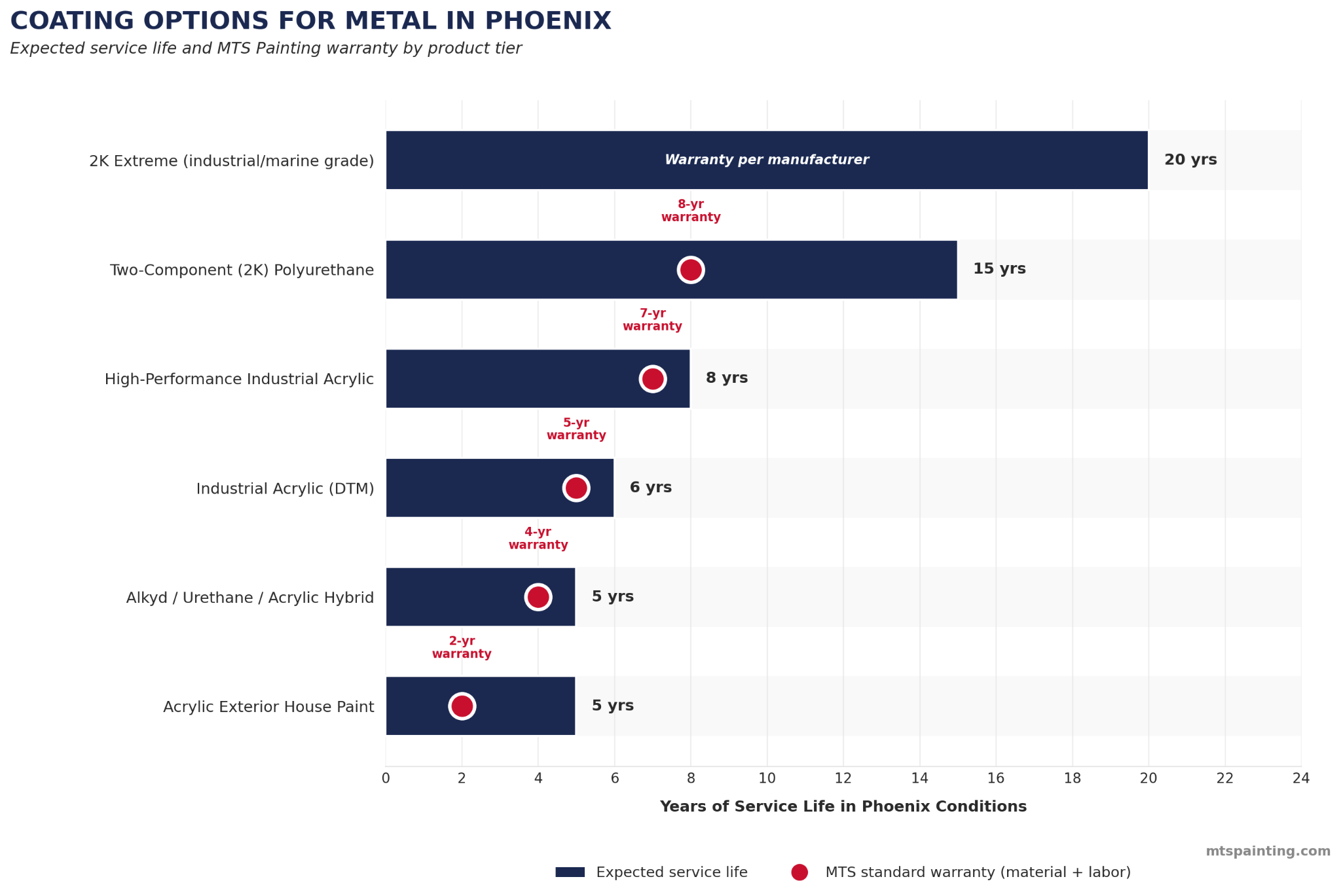
When we issue an estimate for metal, the baseline spec is a high-performance industrial acrylic, which carries our standard 6-year warranty. Solvent-based 2K polyurethane is offered as a durability upgrade with an 8-year warranty, and electrostatic application is offered as a finish and efficiency upgrade on top of that.
How Do We Apply Metal Coatings?
- Brush and roll: Ideal for small jobs and touch-ups. Slower; leaves more texture.
- Mitt: Not used due to poor coverage and inconsistent finish.
- Fine-finish airless spray: Fastest application efficiency, great coverage (film thickness), most overspray, less transfer efficiency, and incomplete wrap on intricate sections or sharp corners.
- Fine-finish HVLP or Air-Assist Airless (cup-gun or paint-pot): Very good coverage, better transfer rate, reasonable application efficiency, incomplete wrap.
- Electrostatic spray: Best transfer rate, least overspray (masking still required), great wrap, reasonable application efficiency, best finish (smoothness).
Why Electrostatic Can be the Right Tool for Metal
Ready to get nerdy? Electrostatic painting works by giving the atomized paint a positive charge as it leaves the gun. The metal object, grounded with a clamp, carries a negative charge and a special spray gun adds a positive charge to the liquid paint as it drifts off the end of the spray gun. Opposite charges attract, so the paint particles pull around every side of the surface: front, back, edges, and undersides, from a single-sided application.
What that means in the field:
- Coverage: Paint efficiently wraps around the back of pickets, brackets, and railings.
- Efficiency: Industry-leading transfer rates (typically 80–95%) mean less material waste.
- Finish quality: Even film build, smooth finish, factory-like appearance.
- Site cleanup: Minimal overspray means less masking, less damage to adjacent surfaces (landscaping), and tenants or homeowners back to their routine sooner.
For a long time, this technology lived inside controlled factory environments. But thanks to mobile electrostatic equipment, we can now deliver the same finish on-site at your HOA, commercial property, or residence.
Frequently Asked Questions About Enamel Paint in Phoenix
Q. What’s the best paint for metal gates and fences in Phoenix?
For most Phoenix-area metal gates and fences, a solvent-based 2K (two-component) polyurethane applied electrostatically delivers the longest service life: typically 10 to 15 years. A high-performance industrial acrylic is a strong, lower-cost alternative that performs well for 5 to 8 years when surfaces are properly prepped.
Q. How long does paint last on metal in the Arizona sun?
Service life depends on the coating system and the prep. In Phoenix, water-based alkyd urethane enamels typically last 4 to 5 years, while high-performance industrial acrylics last 5 to 8 years. Solvent-based 2K polyurethanes last 10 to 15 years. Standard architectural paints, even high-end masonry or siding paints applied to metal without proper prep can fail in as little as 2 to 3 years.
Q. What is electrostatic painting, and how is it different from regular spray painting?
Electrostatic painting positively charges the atomized paint as it leaves the gun, while the metal object is grounded with a clamp to carry a negative charge. The opposite charges attract, pulling paint particles around all sides of the object (including the back and underside) from a single-sided application. Compared to other spray equipment, it offers near-complete wrap coverage, an 80–95% transfer rate (less overspray and waste), and a smoother factory-like finish.
Q. When should I schedule metal painting in Phoenix?
October through April for high visibility perfectly smooth surfaces. The Phoenix summer sun heats dark metal surfaces above 160°F, which flash-dries coatings and can cause adhesion failure, pinholing, and early breakdown. If summer work is unavoidable, we schedule for very early morning hours before surface temperatures climb.
Q. Can rusted metal be repainted, or does it need to be replaced?
Most light to moderate surface rust can be prepped and repainted using wire brushing or sanding followed by a rust-converting or rust-inhibiting primer. Sections that are heavily corroded, structurally compromised, or rusted through (common on gates near pools, sprinklers, or landscaping) need welding repair or replacement. Our estimators identify which is which during the on-site walkthrough. If rust is more than light surface rust, flash rust, or surface oxidation and has become flakey, the smoothness of the metal may be compromised. The metal can be preserved, but the end-result look or aesthetics may not be desirable.
Q. Is solvent-based 2K paint worth the upgrade over water-based enamel?
For high-value, high-traffic, or high-visibility metalwork, like community entry gates, view fencing, light poles, and commercial railings, yes. The 2K polyurethane chemistry is dramatically more durable against UV, chemicals, and abrasion, and typically adds 5 or more years of service life.
Q. Is electrostatic painting safe for occupied properties?
Yes. Electrostatic application produces very little overspray because nearly all of the paint is electrostatically pulled to the grounded surface. That means minimal masking, faster site turnaround, and reduced disruption for tenants, homeowners, and visitors. The process is widely used on occupied HOA, commercial, and residential sites. And all paints have come into the low VOC category thanks to great industry chemists and manufacturers.
Q. How long is MTS Painting’s warranty on metal painting?
MTS Painting’s standard warranty covers both material and labor for 7 years from substantial completion, provided we specify the coating system and apply it ourselves. Upgrading to a 2K polyurethane system extends that to 8 years. That exceeds Arizona’s 2-year minimum workmanship requirement and goes beyond the material-only warranties most local competitors offer. Full warranty terms are available on our website.